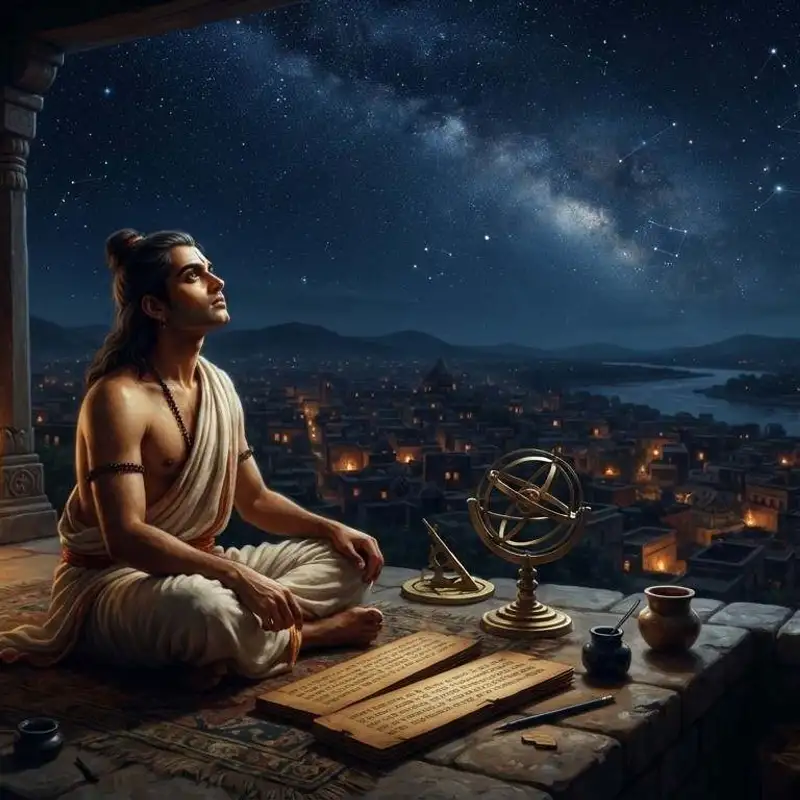
Aryabhata: The Ancient Indian Mathematician Who Calculated the Earth's Rotation to Within One-Hundredth of a Second in 499 CE
In 499 CE a twenty-three-year-old mathematician in ancient Bihar finished writing a book.
The book was 121 stanzas of Sanskrit verse. And in those 121 stanzas he made a series of claims about the universe that the rest of the world would spend the next thousand years catching up to.
The Earth rotates on its own axis. The apparent westward movement of the stars across the night sky is not the stars moving. It is the Earth spinning.
He calculated the Earth's sidereal rotation as 23 hours, 56 minutes and 4.1 seconds.
The modern value, determined by atomic clocks and satellite geodesy, is 23 hours, 56 minutes and 4.091 seconds.
The difference is less than one hundredth of a second.
Copernicus proposed a heliocentric model in 1543. That is one thousand and forty-four years after this mathematician finished his book.
His name was Aryabhata. And this episode is his complete story.
What You Will Discover in This Episode
The complete biography of Aryabhata the mathematician, born in 476 CE in or near Kusumapura, the ancient city that is modern-day Patna in Bihar, who wrote the Aryabhatiya at the age of twenty-three in 499 CE and spent his working life as the head of an institution in the Gupta dynasty's capital at Pataliputra, where he is also believed to have set up an observatory at the Sun temple in Taregana, Bihar
The specific argument Aryabhata used to propose that the Earth rotates, the boat and riverbank analogy in which he explained that the apparent westward movement of the stars is exactly analogous to the apparent backward movement of riverbanks seen from a moving boat, and the extraordinary precision of his calculation of the Earth's sidereal rotation to within one hundredth of a second of the modern value
The calculation of pi to four decimal places in 499 CE and the Sanskrit word asanna that Aryabhata used to explicitly acknowledge that this was an approximation, implying an understanding that pi is irrational that would not be formally established in European mathematics until the 18th century
The correct scientific explanation for solar and lunar eclipses as shadow phenomena, Aryabhata's explicit rejection of the mythological demon explanation for eclipses and the extraordinary precision of his eclipse calculations demonstrated when French astronomer Guillaume Le Gentil found Indian eclipse calculations more accurate than his own European charts in Pondicherry in 1765
The intellectual world that existed outside India in 499 CE, the Ptolemaic geocentric model that would remain dominant in European and Islamic astronomy for over a thousand years, and why the contrast between what Aryabhata was saying in Bihar and what the rest of the world believed makes his achievement so extraordinary
The chain of mathematical influence that Aryabhata set in motion, directly influencing Bhaskara I who wrote the first circle for zero in 629 CE, Brahmagupta who formalised zero's arithmetic properties in 628 CE, and Varahamihira and Brahmagupta whose work would eventually reach Islamic astronomy through the Arabic translation of the Aryabhatiya at the end of the 8th century
The translation of the Aryabhatiya into Arabic at the end of the 8th century at the House of Wisdom in Baghdad, the route by which Aryabhata's mathematical tradition entered European science, eventually embedding itself in the Hindu-Arabic numeral system that the entire modern world uses for every number in every context today
The ancient university of Nalanda in Bihar, where Aryabhata is believed to have studied, which at its peak housed over 10,000 students and 2,000 teachers from across Asia and was the greatest residential university in the ancient world before its destruction by Bakhtiyar Khilji in 1193 CE
The Bihar heritage circuit that 5 Senses Tours covers for international travellers, connecting Patna where Aryabhata worked to Nalanda where he studied to the Mahabodhi Temple at Bodhgaya where the Buddha attained enlightenment and the ancient city of Rajgir where the Buddha himself taught
How the Aryabhata mathematician story connects to the complete ancient Indian science heritage trail that 5 Senses Tours documents across India, from the Iron Pillar of Delhi whose rust-free chemistry was solved by IIT Kanpur to Madhava's calculus in Kerala to Kanada's atomic theory in Gujarat to the Bengali scientists of Presidency College Kolkata
Experience the Aryabhata Mathematician Heritage With 5 Senses Tours
The city where Aryabhata calculated the Earth's rotation is Patna. The university where he studied is Nalanda, now a UNESCO World Heritage Site 90 kilometres from Patna. Both are accessible as part of the most extraordinary Bihar heritage circuit available from any tour operator in India.
Our Patna tours cover the complete ancient Pataliputra heritage including the Kumrahar archaeological site and the full Bihar intellectual and historical landscape at https://5sensestours.com/home-patna-tours/
Our Bodhgaya Buddhist pilgrimage tour covers the complete Bihar heritage circuit including the Mahabodhi Temple at Bodhgaya, Rajgir and Nalanda University at https://5sensestours.com/bodhgaya-buddhist-pilgrimage-tour-mahabodhi-rajgir-nalanda/
Our Nalanda and Rajgir tour covers the UNESCO World Heritage archaeological sites where Aryabhata studied in full depth with expert cultural guides at https://5sensestours.com/tour/nalanda-rajgir/
For the complete ancient Indian scientist heritage journey connecting Aryabhata's Bihar to Madhava's Kerala to Kanada's Gujarat to the Bengali scientists of Kolkata, contact us at https://5sensestours.com/
5 Senses Tours is recognised by India's Ministry of Tourism, winner of the Tripadvisor Travellers Choice Award and the Outlook Responsible Tourism Award. Every tour is private, expert guided and completely customised for your group.