Lakshmi of Pompeii: The Indian Goddess Who Was Buried Under Mount Vesuvius for Nineteen Centuries and What She Tells Us About Ancient India's Global Trade
On the morning of August 24 in the year 79 CE, Mount Vesuvius erupted.
By the following day the Roman city of Pompeii was buried under four to six metres of volcanic ash and pumice. Its buildings, its streets, its citizens and everything they owned were sealed beneath the debris of one of the most catastrophic volcanic eruptions in recorded history.
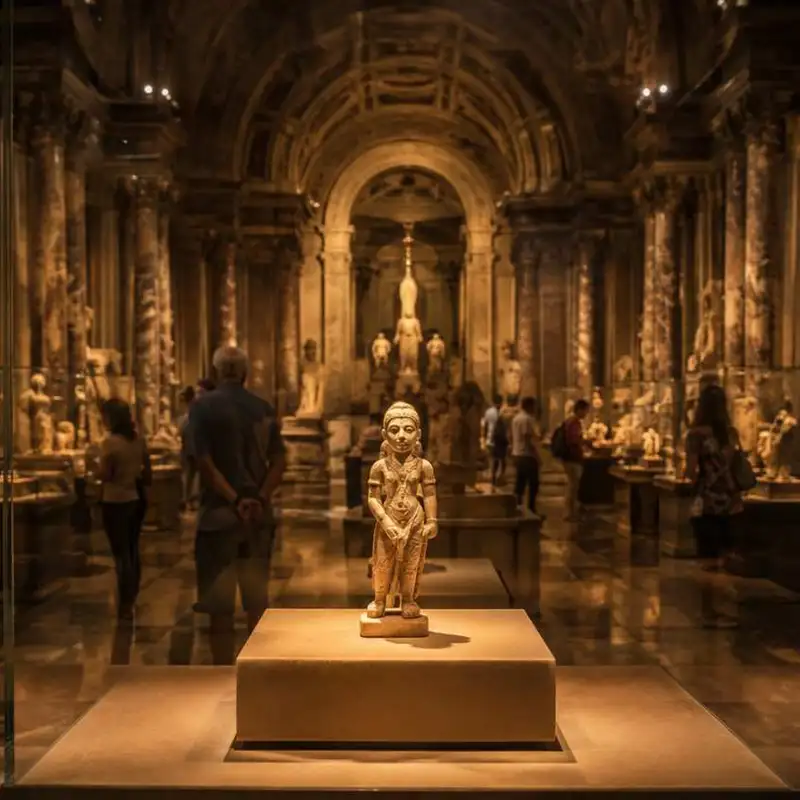
In 1938, Italian archaeologist Amedeo Maiuri and his team were excavating a house in Pompeii next to a large dye works. They found the fragments of a small ivory statuette.
When conservators reassembled those fragments they were looking at an Indian goddess.
Twenty five centimetres tall. Carved from a single elephant tusk. A primary female figure flanked by two smaller attendants, nude except for a waist girdle and elaborate jewellery with elaborate conical earrings. A Kharosthi inscription on the base, the script of northwestern India, suggesting she had passed through the Gandhara region before reaching Italy.
An Indian goddess, buried in volcanic ash since 79 CE, in a private home in one of the Roman Mediterranean's most prosperous trading cities.
She is called the Lakshmi of Pompeii. And this episode is her complete story.
What You Will Discover in This Episode
The complete story of the discovery of the Lakshmi of Pompeii in 1938 by Italian archaeologist Amedeo Maiuri, how the statuette was found in pieces and painstakingly reassembled by conservators, and how her discovery established the existence of flourishing trade networks spanning the Indian Ocean and Mediterranean Sea
The ongoing scholarly debate about who or what the statuette represents, whether she is Lakshmi the Hindu goddess of wealth and prosperity, a yakshi or female nature spirit in the Buddhist artistic tradition, or a syncretic figure blending Indian and Roman iconography, including the Naples museum's 2021 decision to relabel her from Pompeii Lakshmi to Ivory statuette representing an Indian goddess
The competing theories about where in India the statuette was made, from the widely accepted Bhokardan in Maharashtra where two similar ivory figurines were found, to Mathura in Uttar Pradesh, to the Gandhara region in present-day Pakistan or Afghanistan suggested by the Kharosthi inscription on her base
The significance of her discovery location in a house next to a large dye works in Pompeii, the connection to indigo as a likely trade commodity between India and Rome, and what this tells us about the kind of merchant who probably owned her
The Periplus of the Erythraean Sea, the first-century CE Greek merchant's guide to sailing from Roman Egypt across the Indian Ocean to the ports of western India, and what it tells us in precise commercial detail about the trade network that carried the Lakshmi of Pompeii from Maharashtra to Pompeii
The port of Bharuch in Gujarat, the Barygaza of the Periplus and the greatest western emporium of the ancient Indo-Roman trade network, what it exported to Rome, what it imported from Rome, and why it was most likely the departure point for the statuette's journey across the Indian Ocean
The inland Deccan trade routes of the Satavahana dynasty that connected the production cities of Maharashtra, including Paithan, Ter and Bhokardan, to the western ports, and how bullock carts carried the luxury goods of the Deccan plateau to the ships that sailed to Rome
The evidence for the scale of ancient Indo-Roman trade including Roman gold coins found at Indian sites, Roman wine amphorae discovered at Nevasa in Maharashtra, and the discovery that the ancient Indian iron-making tradition was already producing export-quality goods for the Roman luxury market
The Indian sites that can be visited today to experience the physical heritage of this ancient global trade story, from the port of Bharuch in Gujarat to the Indus Valley sites of Dholavira and Lothal to the Muziris heritage circuit at Pattanam near Kochi in Kerala to the Satavahana heritage of Maharashtra
How 5 Senses Tours brings the complete ancient Indian trade heritage to life for international travellers through expert guided private experiences at the ports, inland cities and archaeological sites that formed the Indian side of the trade network that sent an ivory goddess to Pompeii
Experience the Ancient Indian Trade Heritage With 5 Senses Tours
The Lakshmi of Pompeii is today in the National Archaeological Museum in Naples. But the ports that sent her, the inland cities whose craftsmen made her and the trading tradition that carried her across the Indian Ocean are still part of the living heritage of India.
Our Ahmedabad tours cover the Gujarat heritage circuit including the region of ancient Bharuch, the most likely departure point for the statuette's journey to Rome, as well as the Indus Valley cities of Dholavira and Lothal at https://5sensestours.com/home-ahmedabad-tours/
Our Dholavira tour covers the UNESCO World Heritage Indus Valley city in the Rann of Kutch, placing the Indo-Roman trade era within four thousand years of Gujarat maritime heritage at https://5sensestours.com/tour/dholavira-tour/
Our Lothal tour covers the ancient Indus Valley port city near Ahmedabad whose dry dock is the world's earliest known at https://5sensestours.com/tour/lothal-tour/
Our Kochi tours cover the complete Muziris heritage circuit at Pattanam near Kodungallur, where Roman gold coins and wine amphorae confirm the intensity of first-century Indo-Roman trade on the Kerala Malabar Coast at https://5sensestours.com/home-kochi-tours/
For a customised private journey connecting the ancient Indian trade heritage from Gujarat to Kerala, contact us at https://5sensestours.com/
5 Senses Tours is recognised by India's Ministry of Tourism, winner of the Tripadvisor Travellers Choice Award and the Outlook Responsible Tourism Award. Every tour is private, expert guided and completely customised for your group.