Malpe Fishing Community: The Original Fishermen of the Karnataka Coast and Why They Are Being Pushed Out of the Sea They Have Always Fished
The boats leave before you are awake.
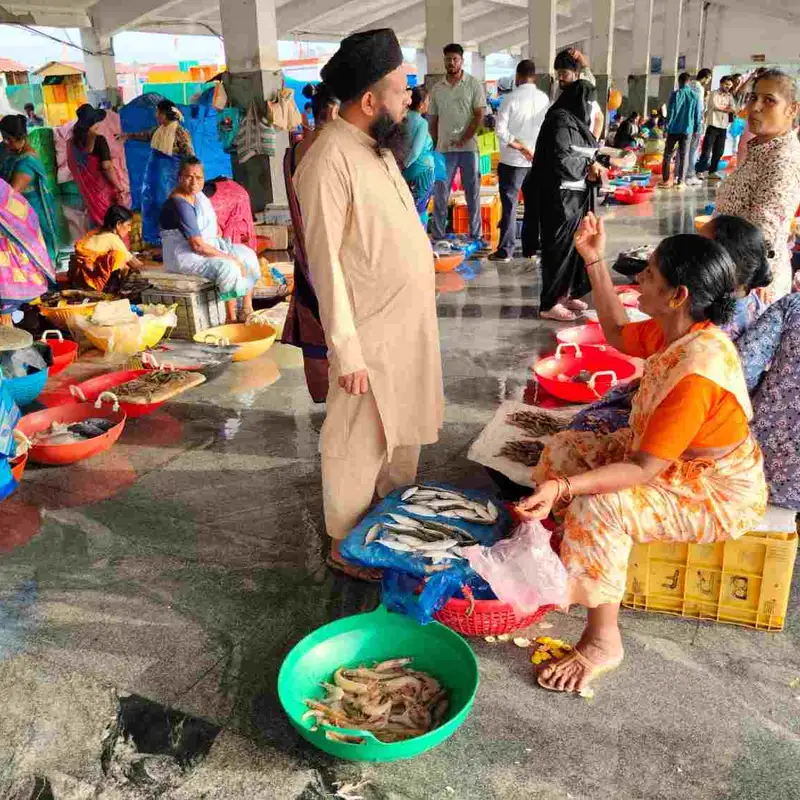
By the time visitors arrive at Malpe harbour in the morning, the day's work has already been underway for hours. The fishing families of Malpe do not operate on tourist time. They operate on the rhythm of the sea, which means departures in the dark, returns determined by the catch, and the women at the harbour ready to receive, sort and sell before the sun climbs high enough to compromise what has been pulled from the water.
Malpe is one of the most active fishing harbours on the Karnataka coast. Its covered fish market, where prawns and mackerel are laid out in the early hours by women vendors whose families have been in this trade for generations, is a working commercial operation, not a heritage display. The noise and the smell and the speed of the transactions happening around you are not constructed for visitors. They are the actual morning of a community that has fed the coastal Karnataka region for as long as anyone can trace.
And that community calls itself the moola. The original fishermen of Dakshin Kannada. The word means original in Kannada. And they use it deliberately, because what is happening to them is not a natural evolution of their trade. It is a displacement. From the sea they have always fished. By forces they had no part in creating and over which they have no power.
In 2005, 85 percent of the catch on the Karnataka coast was taken by the mechanised sector. The artisanal fishermen, working smaller traditional craft in the inshore waters, were left with the remainder. A regulation passed in 1994 reserves the ten-kilometre inshore zone for traditional fishermen. It has not been enforced. The operational costs of fishing, diesel, ice, boat maintenance, have doubled in recent years. The catch has not increased. And the younger generation is looking at what their parents earn and leaving for the city.
This episode is the complete story of the Malpe fishing community.
What You Will Discover in This Episode
The complete story of the Mogaveera fishing community of Malpe, their identity as the moola or original fishermen of Dakshin Kannada, their centuries-old relationship with the Karnataka coast, and what their daily working life actually involves from the pre-dawn departure to the morning's market transactions managed by the women of the community
How the mechanised expansion of the Karnataka fishing industry from the 1960s onward, driven by government policy that prioritised production volume over sustainable management and the protection of traditional fisherfolk, has progressively squeezed the artisanal community out of the resource they built their entire culture around
The specific numbers that define the crisis, 85 percent of the catch taken by the mechanised sector, the 1994 ten-kilometre inshore zone regulation that exists on paper and has never been enforced, operational costs that have doubled in recent years without a corresponding increase in catch, and the steady outmigration of the younger generation toward urban employment
The role of the women of Malpe as the commercial engine of the fishing operation, managing the daily sale of what the men bring from the sea at the covered harbour market, their knowledge of pricing and buyer relationships as essential to the community's livelihood as the fishing itself, and what it means that this knowledge and this role are both threatened when the fishing trade becomes unviable
What the Malpe harbour actually looks like and sounds and smells like at full activity in the early morning hours, the ice loading, the net preparation, the return of the boats, the rapid transactions at the market, and why experiencing this in its actual working context rather than as a curated heritage display is the only honest way to understand what is at stake
The wooden temple chariot procession ritual and the walk around Asthamata temple pond and the Malpe beach and shopping streets that form the social and cultural fabric of the community beyond the harbour, demonstrating that what is at risk in Malpe is not simply a livelihood but a complete way of life organised around the sea
How the 5 Senses Tours Coast to Canopy trail approaches the Malpe visit, timed around the real rhythm of the catch rather than a fixed visitor slot, with direct payment to the community after every visit creating a non-extractive income source tied to the fishermen's knowledge and way of life rather than their catch
Why a non-extractive income stream is specifically the right intervention for the Malpe community, a community that does not need more extraction from the sea but more income that is not dependent on it, and how the visit model creates exactly that without requiring any additional pressure on the resource the community is already struggling to access
How the Malpe visit fits within the complete seven-day Coast to Canopy Regenerative Trail connecting the cotton weavers of Talipady, the jasmine farmers of Shankarapura, the fishing community of Malpe, the Vedic students of Swarnavalli Mutt and the temple priests of Banavasi across coastal Karnataka and the Western Ghats
Experience the Malpe Fishing Community With 5 Senses Tours
The boats are already out. The women are already at the market. The ice is already loaded on the vessels preparing for the next departure. By the time you arrive at Malpe harbour on the Coast to Canopy trail, the community's day is already several hours old.
That is the point. You are not visiting a performance of fishing life. You are entering a working harbour on the terms of the people who work it, at the hour when the work is actually happening, and hearing directly from the fishermen themselves what a day at sea involves and what they are up against.
Our Coast to Canopy Regenerative Trail visits the Malpe fishing community as part of a seven-day private experience across coastal Karnataka and the Western Ghats. Groups are small, always private, never exceeding eight people, and 5 Senses Tours pays the community directly after every visit.
For the complete Coast to Canopy Regenerative Trail across coastal Karnataka and the Western Ghats, contact us at https://5sensestours.com/
5 Senses Tours is recognised by India's Ministry of Tourism, winner of the Tripadvisor Travellers Choice Award and the Outlook Responsible Tourism Award. Every tour is private, expert guided and completely customised for your group.