The Art That Fire Makes Permanent: Varanasi Enamelling and Its Three Thousand Year Global Journey
There is a colour that changed the history of art on three continents. It is called the Purple of Cassius and it connects a working studio in Varanasi to the painted enamel houses of Limoges in France, to the Persian court of the medieval period, to the Mycenaean Greece of 1450 BCE and to the fragile silver heritage of the Andaman coast. In this episode we follow that thread across three thousand years of human craft history and arrive, at the end of it, in a kiln-lit studio in one of the world's oldest cities where the same chemistry is still alive in the hands of a working artist.
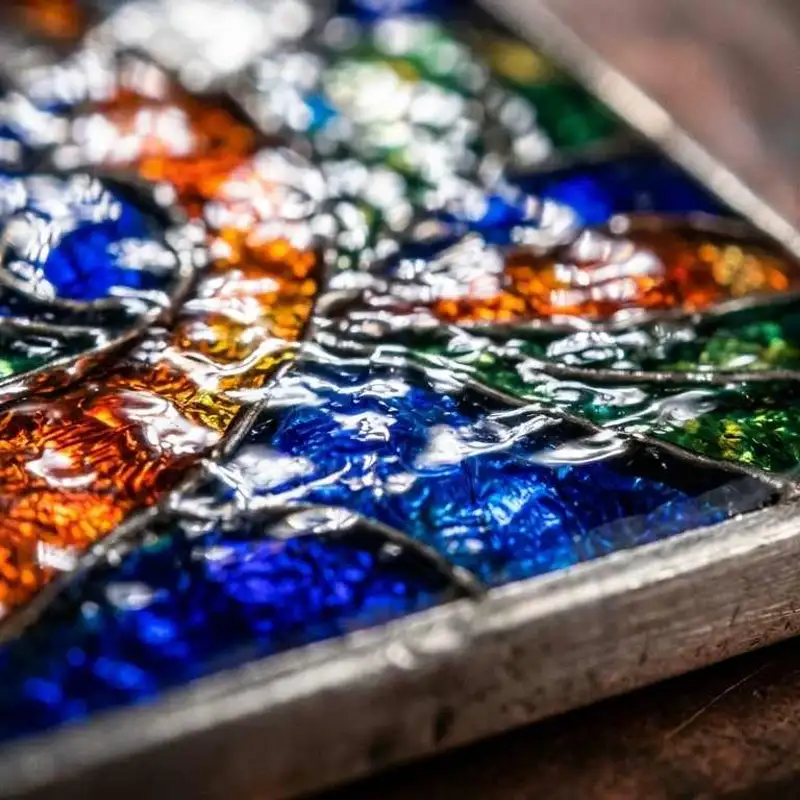
Enamelling is the art of fusing powdered glass onto metal at temperatures between 750 and 850 degrees Celsius. The result is a coloured surface that is chemically bonded to the metal and effectively permanent on any human timescale. The enamel jewellery found in Mycenaean graves dating to 1450 BCE is still the same colour it was three thousand years ago. No painted surface from the same period survives with its colour intact.
This episode tells the complete global story of enamelling: how it was developed independently in ancient Greece, Egypt and China, how it reached the Persian court and then the meenakari tradition of Mughal India under Emperor Akbar, how it connected Varanasi to the enamel houses of Limoges through the shared chemistry of the Purple of Cassius, and how it arrived at its present moment in Varanasi, where the number of working enamellists has fallen sharply over three decades and where what happens in one working studio on weekend mornings is an act of craft preservation as much as it is an art practice.
What You Will Hear in This Episode
Why enamelling is the only art form in which the colour is not applied to the surface but fused into it, and why that single fact explains everything about the craft's three thousand year survival.
The story of the Purple of Cassius: what it is, how it is made, and why a colour produced by dissolving gold in acid connected craftspeople in Persia, India and France who had no direct contact with each other.
How Emperor Akbar brought Persian enamellists to the Mughal court in the 16th century and what happened to that knowledge when it arrived in Varanasi.
Why Varanasi specifically, a city whose ghats have been lit by cremation fires for over three thousand years, is the right place for an encounter with a craft whose entire logic depends on what fire does to fragile materials.
The Andaman connection: how a remote island archipelago became the unexpected meeting point of craft traditions from Rajasthan, Tamil Nadu and Burma, and how that convergence produced the silver jewellery tradition that gives The Andaman Way its name.
What responsible tourism looks like when the community is a single working artist in an urban studio rather than a rural farming or weaving community, and why the economic signal of a booking matters as much here as it does on the Coast to Canopy trail.
What it feels like to make something that will almost certainly outlast you.
Key Moments
00:00 — Introduction: the Purple of Cassius and the colour that changed the history of art
04:30 — What enamelling actually is and why colour fused into glass never fades
09:15 — The oldest known enamel objects: Mycenaean Greece, 1450 BCE
13:40 — The Persian court, the trade routes and the road to Limoges
19:20 — How the meenakari tradition reached India through Emperor Akbar and the Mughal court
24:45 — Varanasi enamelling: its specific character and its connection to the city's three thousand year relationship with fire
31:10 — The Andaman connection: where craft histories converge unexpectedly
36:30 — Why enamelled objects last three thousand years: the chemistry of permanence
41:15 — What hands learn that eyes cannot: the embodied knowledge inside Varanasi's enamelling tradition
47:00 — Responsible tourism and craft preservation: why your booking matters
51:30 — The Andaman Way: meeting Soma Pradhan in her Varanasi studio
Resources and Links
Book The Andaman Way Enamelling Workshop in Varanasi:
5sensestours.com/tour/the-andaman-way-varanasi-enameling-workshop/
5sensestours.com/tour/the-andaman-way-varanasi-enameling-workshop/
Read the full blog on the history of Varanasi enamelling:
5sensestours.com/varanasi-enamelling-history-limoges-persia-ancient-craft/
5sensestours.com/varanasi-enamelling-history-limoges-persia-ancient-craft/
The Andaman Way by Soma Pradhan:
Available on Amazon India and Amazon globally
Available on Amazon India and Amazon globally
Byzantine enamelwork from Constantinople:
Treasury of San Marco, Venice
Kunsthistorisches Museum, Vienna
Treasury of San Marco, Venice
Kunsthistorisches Museum, Vienna
Limoges painted enamel collections:
The Louvre, Paris
Victoria and Albert Museum, London
Metropolitan Museum of Art, New York
The Louvre, Paris
Victoria and Albert Museum, London
Metropolitan Museum of Art, New York
5 Senses Tours:
5sensestours.com
Outlook Responsible Tourism Award recipient
Tripadvisor Travellers Choice 2025
Ministry of Tourism Recognised
4.9 Stars across 1,350 reviews
5sensestours.com
Outlook Responsible Tourism Award recipient
Tripadvisor Travellers Choice 2025
Ministry of Tourism Recognised
4.9 Stars across 1,350 reviews
About 5 Senses Tours
5 Senses Tours is an award winning cultural tour operator recognised by India's Ministry of Tourism, founded by Madhusudan Narayanan with a single conviction: that the best way to travel is as a traveller and not as a tourist. Every tour is private, expert guided and completely customised for your group, with a maximum of eight guests. The company has been guiding international travellers from the USA, UK, Australia and beyond through India's most extraordinary heritage destinations since 2015, earning the Tripadvisor Travellers Choice Award, the Outlook Responsible Tourism Award and a 4.9 star rating across 1,350 reviews.
About the Host
Madhusudan Narayanan is the Founder and CEO of Five Senses Tours, a certified Incredible India Tourism Facilitator recognised by India's Ministry of Tourism. A BITS Pilani alumnus with a postgraduate degree in Communications from MICA Ahmedabad, he has spent over a decade transforming how international travellers experience India's living heritage. His personal curiosity ranges from Indian philosophy and wildlife to ancient Indian science and the expanding universe.