The Iron Age Did Not Begin in Turkey: How Tamil Nadu Rewrote the History of Human Civilisation
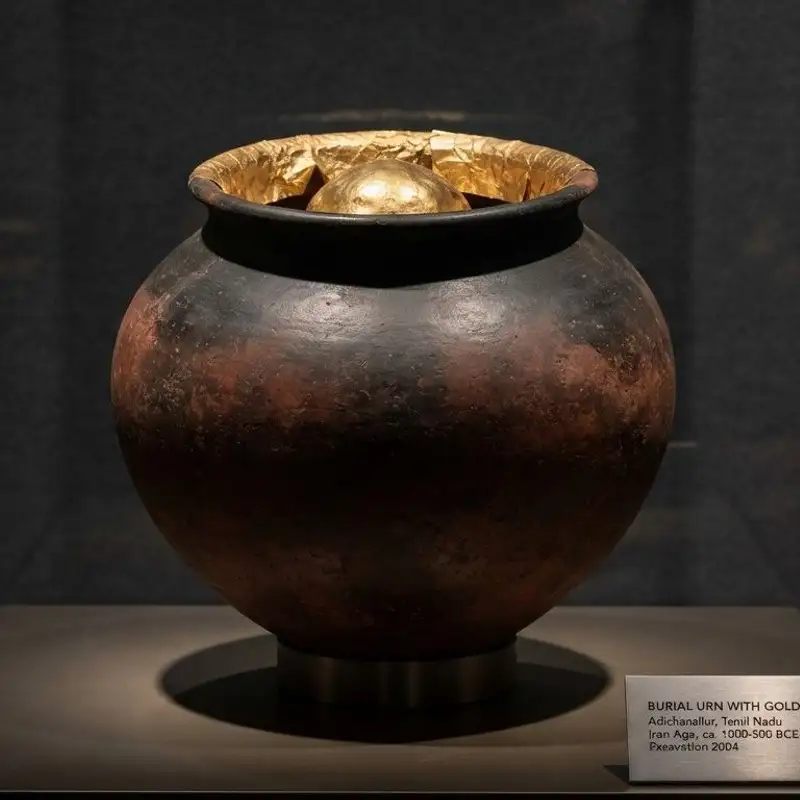
In 1876 a German archaeologist named Friedrich Jagor began digging in a field near Tirunelveli in southern Tamil Nadu and found something that should have rewritten the history of human civilisation. He found burial urns containing human skulls covered in thin sheets of beaten gold. He found iron artefacts. He filed his report and the world moved on.
Over a century later the Tamil Nadu State Department of Archaeology resumed excavations at the same site, Adichanallur, and at a nearby site called Sivagalai. What the carbon dating returned stopped everyone in the room. The organic materials found alongside iron artefacts at Adichanallur averaged 2,613 BCE, over 4,600 years ago. At Sivagalai the date was 3,345 BCE, over 5,300 years ago.
The conventionally accepted beginning of the global Iron Age in Anatolia is approximately 1,200 BCE.
Tamil Nadu was smelting iron over two thousand years before that. And it may have done so entirely independently, because the geology south of the Vindhya range gave these communities iron ore but no copper, meaning they may have bypassed the Bronze Age entirely and moved directly from stone to iron while the Harappan civilisation was still discovering copper in the north.
In this episode we follow the complete story of these discoveries: what was found, what it means, why South India may have invented the Iron Age independently, what the ongoing scholarly debate is about and why visiting the Tamirabarani valley now, before these sites become famous, is one of the most extraordinary things a person curious about human history can do.
What You Will Hear in This Episode
What Friedrich Jagor found at Adichanallur in 1876 and why it took over a century for the world to understand what it meant.
The carbon dating results from Adichanallur and Sivagalai in full, what the dates are, how they were obtained, what they were obtained from and what they imply for the global history of iron technology.
Why the Tamil Nadu Iron Age may have developed entirely independently of every other iron-working tradition in the ancient world, and the geological argument that explains how this was possible.
What the Harappan or Indus Valley Civilisation was doing with copper at exactly the moment communities on the Tamirabarani River were already working with iron, and what this comparison tells us about the story of ancient India.
The extraordinary burial tradition of Adichanallur: gold-covered skulls, black-and-red ware pottery and a civilisation that left no written records but left behind objects that outlasted everything the ancient world thought it knew about South India.
The discovery at Thirumalapuram reported in 2025 and what it confirms about Adichanallur being not an isolated site but the most visible node of a broader Iron Age cultural network across the Tamirabarani valley.
Why the Tamil word for iron, irumbu, has no known cognate in any language family that would indicate a borrowed word for a borrowed technology, and what that linguistic evidence adds to the case for independent invention.
The ongoing scholarly debate: what is accepted, what is still being discussed and what the ongoing excavations are likely to reveal.
What visitors can see at these sites today and why now is the moment to go, before the museum is built and the tourist infrastructure arrives and the quiet of a place that holds its significance invisibly is replaced by the noise of the world discovering it.
Key Moments
00:00 — Introduction: the discovery at Adichanallur and why it matters
04:15 — What Friedrich Jagor found in 1876 and why the world was not ready to hear it
09:30 — The carbon dating results: 2,613 BCE at Adichanallur and 3,345 BCE at Sivagalai
15:45 — The Harappan comparison: copper in the north, iron in the south, at the same moment in history
21:20 — Why South India may have invented the Iron Age independently: the geological argument
27:40 — The burial tradition: gold-covered skulls, black-and-red ware pottery and a civilisation without written records
33:15 — Thirumalapuram 2025: the new site that confirms a broader cultural network
38:50 — The Tamil word irumbu and the linguistic evidence for independent invention
44:10 — The scholarly debate: what is accepted, what is still being discussed
49:30 — What visitors can see today and why now is the moment to go
54:00 — The Tamirabarani valley as part of the broader Tamil Nadu civilisational arc: Keeladi, Mahabalipuram, Thanjavur, Chennai
58:30 — Closing thoughts: the river that was producing iron for the ancient world 5,300 years ago, still moving, still here
Resources and Links
Read the full blog:
5sensestours.com/adichanallur-sivagalai-tamil-nadu-iron-age-history/
5sensestours.com/adichanallur-sivagalai-tamil-nadu-iron-age-history/
Tamil Nadu State Department of Archaeology:
tnarch.gov.in
tnarch.gov.in
The Antiquity of Iron report:
Published by the Tamil Nadu State Department of Archaeology, available through the department directly
Published by the Tamil Nadu State Department of Archaeology, available through the department directly
Adichanallur site location:
Approximately 24 kilometres from Tirunelveli, Thoothukudi district, Tamil Nadu
Approximately 24 kilometres from Tirunelveli, Thoothukudi district, Tamil Nadu
Sivagalai site location:
Srivaikuntam taluk, Thoothukudi district, Tamil Nadu, approximately 35 kilometres from Tirunelveli
Srivaikuntam taluk, Thoothukudi district, Tamil Nadu, approximately 35 kilometres from Tirunelveli
Thirumalapuram excavation coverage:
Outlook Traveller, October 2025
Outlook Traveller, October 2025
The Wire coverage of Tamil Nadu iron age findings:
thewire.in
thewire.in
Keeladi excavation:
Archaeological Survey of India, Sivagangai district, Tamil Nadu
Archaeological Survey of India, Sivagangai district, Tamil Nadu
Explore Tamil Nadu tours with 5 Senses Tours:
5sensestours.com/home-chennai-tours/
5sensestours.com/home-chennai-tours/
Mahabalipuram private tour:
5sensestours.com/home-mahabalipuram-tours/
5sensestours.com/home-mahabalipuram-tours/
Thanjavur private tour:
5sensestours.com/home-thanjavur-tours/
5sensestours.com/home-thanjavur-tours/
Talk to us about a custom South Tamil Nadu heritage itinerary:
5sensestours.com/contact-button/
5sensestours.com/contact-button/
5 Senses Tours:
5sensestours.com
Outlook Responsible Tourism Award recipient
Tripadvisor Travellers Choice 2025
Ministry of Tourism Recognised
4.9 Stars across 1,350 reviews
Maximum 8 guests per tour
5sensestours.com
Outlook Responsible Tourism Award recipient
Tripadvisor Travellers Choice 2025
Ministry of Tourism Recognised
4.9 Stars across 1,350 reviews
Maximum 8 guests per tour
About 5 Senses Tours
5 Senses Tours is an award winning cultural tour operator recognised by India’s Ministry of Tourism, founded by Madhusudan Narayanan with a single conviction: that the best way to travel is as a traveller and not as a tourist. Every tour is private, expert guided and completely customised for your group, with a maximum of eight guests. The company has been guiding international travellers from the USA, UK, Australia and beyond through India’s most extraordinary heritage destinations since 2015, earning the Tripadvisor Travellers Choice Award, the Outlook Responsible Tourism Award and a 4.9 star rating across 1,350 reviews.
About the Host
Madhusudan Narayanan is the Founder and CEO of Five Senses Tours, a certified Incredible India Tourism Facilitator recognised by India’s Ministry of Tourism. A BITS Pilani alumnus with a postgraduate degree in Communications from MICA Ahmedabad, he has spent over a decade transforming how international travellers experience India’s living heritage. His personal curiosity ranges from Indian philosophy and wildlife to ancient Indian science and the expanding universe.
Short Episode Description
For Spotify, Apple Podcasts and similar platforms. Under 200 words.
For Spotify, Apple Podcasts and similar platforms. Under 200 words.
In 1876 a German archaeologist found burial urns in southern Tamil Nadu containing human skulls covered in beaten gold. The world moved on. Over a century later the Tamil Nadu State Department of Archaeology returned to the same site, and the carbon dating changed everything.
The organic materials found alongside iron artefacts at Adichanallur averaged 2,613 BCE. At the nearby site of Sivagalai the date was 3,345 BCE, over 5,300 years ago. The conventionally accepted beginning of the global Iron Age in Anatolia is approximately 1,200 BCE.
Tamil Nadu was smelting iron over two thousand years before that. And it may have done so entirely independently, because the geology south of the Vindhya range gave these communities iron but no copper, meaning they may have bypassed the Bronze Age entirely and moved directly from stone to iron while the Harappan civilisation was still discovering copper in the north.
In this episode we follow the complete story of these discoveries, what was found, what it means, why the world has not yet heard it, and why the Tamirabarani valley is one of the most significant and least visited heritage destinations on earth.
Plan your South Tamil Nadu heritage journey at 5sensestours.com.