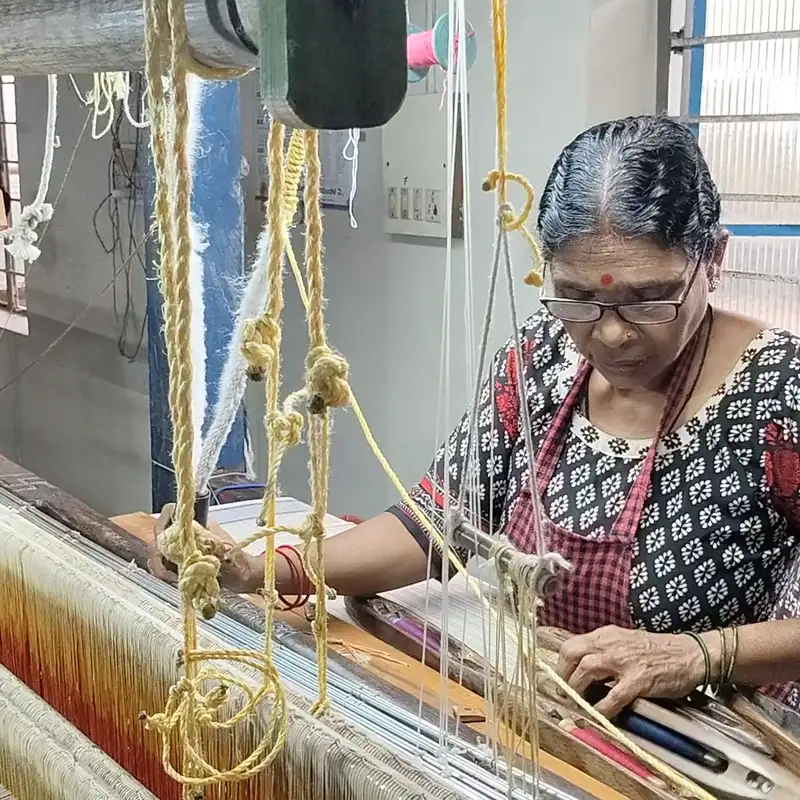
Udupi Cotton Weavers: The Last Forty-Two Families Keeping a 200-Year-Old Craft Alive at Talipady
In 2017 the Kadike Trust conducted a survey of Udupi cotton saree weavers across two districts of coastal Karnataka.
They found forty-two.
Not forty-two workshops. Not forty-two cooperatives. Forty-two individual weavers still practising a craft that had once supported over five thousand weaving families in the same region.
This is not a story about a craft that died. It is a story about a craft that is still alive, barely, in the hands of the families at the Talipady Weavers Society, and about what it would take for it to remain alive long enough for the next generation to inherit it.
The Udupi cotton saree is not simply a cotton saree made in Udupi. It is a specific textile with a specific construction method that cannot be replicated on a power loom without losing the qualities that make it worth having. The sizing material is applied directly to the yarn while the weaving is in progress, a technique known as loom sizing, using a special brush made from the bristles of the fish tail palm tree. This on-loom sizing gives the finished cloth its distinctive crispness and shine. It reduces yarn breakage during weaving. And it cannot be automated. It is a manual process that requires the weaver's hands, eyes and spatial awareness at every moment of the work.
When the last weaver who knows how to do this stops working, it is gone. Not preserved in a museum. Not documented in a manual. Gone.
This episode is the complete story of the Udupi cotton weavers of Talipady.
What You Will Discover in This Episode
The complete story of the Udupi cotton saree tradition, which once supported over five thousand weaving families across Dakshina Kannada and Udupi districts and now survives in the hands of forty-two weavers identified in a 2017 survey, and what happened to reduce a thriving cooperative tradition to the edge of extinction in the space of three decades
What makes the Udupi cotton saree technically distinct from any power loom imitation, including the specific on-loom sizing technique using a brush made from the fish tail palm tree, the single ply combed cotton yarn counts that give the cloth its distinctive weight and hand feel, and the cooperative tradition that Mahatma Gandhi's freedom movement established in Dakshina Kannada as the institutional structure for this craft
How the forces of post-liberalisation market flooding, including cheap power loom imitations sold under the Udupi name, eroded the economic case for handloom weaving in ways that the Geographical Indication tag and cooperative protections have not been sufficient to reverse
Why the younger generation of weaving families is leaving the craft and what the loss of each weaver means not simply in terms of production capacity but in terms of the embodied knowledge of loom sizing, yarn tension and the visual vocabulary of Udupi saree design that cannot be retrieved once the person who holds it stops practising
What the 5 Senses Tours Coast to Canopy trail actually looks like at Talipady, the weaving families deciding how much of their process to open to visitors, the complete production chain from yarn in the dyeing vat to warp thread on the working loom visible in a single visit, and what makes this different from a heritage display or a cultural performance
How the direct payment model of the Coast to Canopy trail, in which 5 Senses Tours pays each community directly after every visit as a guaranteed part of the trip structure rather than something left to visitor goodwill, creates a dependable income stream that gives weaving families a genuine economic reason for the next generation to stay with the craft
The fish tail palm tree, whose bristles are used for the loom sizing brush and which is itself under threat in coastal Karnataka, adding an ecological dimension to the craft's precarity that connects the Udupi cotton saree tradition to the broader environmental story of the Western Ghats coastal landscape
How the Talipady visit fits within the seven-day Coast to Canopy Regenerative Trail that connects the cotton weavers to the jasmine farmers of Shankarapura, the fishing community of Malpe, the Vedic students of Swarnavalli Mutt and the temple priests of Banavasi across a complete cross-section of the living craft and cultural heritage of coastal Karnataka and the Western Ghats
Experience the Udupi Cotton Weavers With 5 Senses Tours
The loom at Talipady is still running. The fish tail palm brush is still being used. The forty-two weavers identified in 2017 are still working. And the families whose hands hold this tradition are still making the daily decision about whether to continue.
The Coast to Canopy trail visits the Talipady Weavers Society as part of a seven-day private regenerative journey across coastal Karnataka and the Western Ghats. Groups are small, always private, never exceeding eight people, and every community on the trail receives direct payment from 5 Senses Tours after every visit.
For the complete Coast to Canopy Regenerative Trail across coastal Karnataka and the Western Ghats, contact us at https://5sensestours.com/
5 Senses Tours is recognised by India's Ministry of Tourism, winner of the Tripadvisor Travellers Choice Award and the Outlook Responsible Tourism Award. Every tour is private, expert guided and completely customised for your group.